Make a knitting chart from a picture
Choose a picture below, set the width in stitches, the colors and your gauge, and Moonleaf makes a colorwork chart with cells shaped like knit stitches and row-by-row color counts. Knit stitches are wider than tall, so a chart drawn on square paper comes out squashed. At 20 stitches × 24 rows per 4 inches, a picture 50 stitches wide needs 80 rows, not 67. It also flags rows with more than 2 colors and long floats.
Make a knitting colorwork chart from a photo
Runs in your browser. Nothing is uploaded. No sign-up.
No photo handy?
60 stitches wide · choose a photo to see the height
More options
Pinch or scroll to zoom, drag to move. Tap a color in the key to highlight it.
Moonleaf Pro is coming soon · $4.99 per chart or $14.99 lifetime
- The printable PDF: cover, color key with amounts, chart pages with a page map
- Written row-by-row instructions for C2C and row crafts
- Charts up to 400 stitches wide and 70 colors
Everything above is free while we launch. Leave your email and we'll write once, when Pro is ready.
Why do knitting charts need a different grid?
A knit stitch is wider than it is tall. Two of the most popular worsted yarns list these gauges on their labels (as shown on Ravelry): Red Heart Super Saver, 17 stitches × 23 rows per 4 inches, and Lion Brand Vanna’s Choice, 16 × 22. Each stitch is about 1.35 times wider than tall. Vogue Knitting’s colorwork graph paper uses 5 stitches × 6 rows per inch for stranded knitting and 6 × 8 for intarsia. Knitty calls knitter’s graph paper boxes drawn in “the actual proportions of knit stitches”.
Chart a picture on square paper and knit it, and it comes out shorter and wider than the picture. Moonleaf works the rows out from your gauge instead. It starts at 20 stitches × 24 rows per 4 inches (Vogue Knitting’s stranded proportion); type your own swatch numbers in the tool. In our example, a picture 960 × 1,280 pixels and 50 stitches wide needs 80 rows at that gauge. A square grid would give it only 67.
How do I read the chart?
Tin Can Knits’ guide sums up the rules:
- Work from the bottom up. Row 1 is the bottom row of the chart, starting at the lower right.
- Flat: right-side rows are read right to left, wrong-side rows left to right.
- In the round: every round is read right to left.
Moonleaf numbers rows from the bottom and stitches from the right, with bold lines every 10 from that corner. The written rows list colors in the order you knit them, so “Row 2 → (WS): 34 B, 16 A” is already reversed for the purl side. Set Worked: In the round under More options for hats, yokes and mittens.
A worked example: a lighthouse in two colors
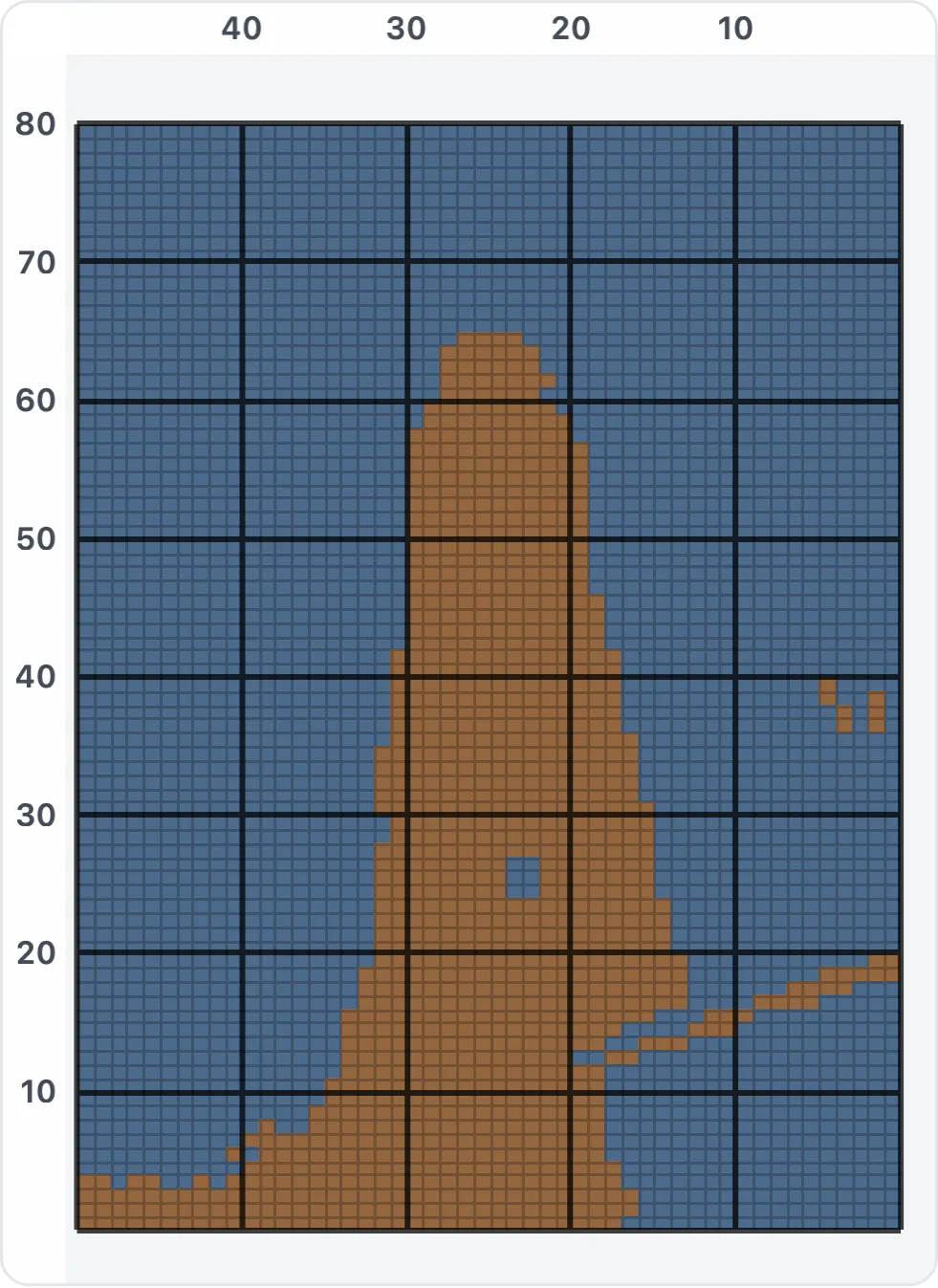
We charted a public-domain photo of Happisburgh Lighthouse (CC0) at 50 stitches wide, gauge 20 × 24 per 4 inches:
- With 2 colors: 50 × 80 stitches, 4,000 stitches, 10 × 13.3 inches. Every row has 2 colors or fewer, but the longest float is 34 stitches, because the sky beside the lighthouse is one color for most of the row. Yarn: about 122 yards with floats and the 15% margin.
- With 4 colors: the same size, but 48 of the 80 rows use more than 2 colors. That’s fine for intarsia and hard for stranded knitting.
The chart took 14 to 21 milliseconds and the PDF 0.15 to 0.25 seconds over three runs, in Safari’s engine (Playwright WebKit 27.2) at an iPhone 15 screen size on an Apple M4 Mac.
Stranded or intarsia: which suits my picture?
Stranded (Fair Isle) carries both colors across the back of every row. Traditional Fair Isle uses “only two colours per row” (Sheila McGregor, cited on Wikipedia), and Tin Can Knits says “two colours (sometimes more)”. It suits small, repeating motifs and pictures with colors spread evenly across the rows.
Intarsia knits each block of color from its own bobbin and doesn’t carry yarn across the back. It suits pictures with big single-color areas: a figure on a plain background, a lighthouse against the sky.
Moonleaf checks your chart for both:
- Colors per row: how many rows use more than two colors.
- Longest float: the longest run of one color in a row with another color in it. That’s how far the other color has to travel behind the work.
How long can floats be?
Advice varies with the garment:
| Source | Catch floats longer than |
|---|---|
| Berroco, cuffs and mittens | about 5 stitches |
| Berroco, yokes and hats | up to 7 stitches |
| Berroco, babies and toddlers / older children | 2 / 3 stitches |
| Wikipedia (Fair Isle) | 3 to 5 stitches |
| Tin Can Knits | “every 3, 5, 7, 10+… but we almost never do” |
Small pixel-art motifs chart especially cleanly, one pixel per stitch (pixel art to cross stitch explains how the tool detects them). If the float check shows long runs, try fewer stitches of background (crop closer), knit those areas in intarsia, or add the small details afterwards in duplicate stitch.
How much yarn will each color take?
No yarn company publishes yarn per knit stitch, so we start from textile research. In plain knitting, the yarn in one stitch (the loop length) times the stitches per unit width comes out close to a constant. Published values for wool are about 4.1 to 4.8, so a stitch uses roughly 4 to 5 stitch widths of yarn. Moonleaf uses 4.5 stitch widths a stitch. For stranded work it adds each color’s floats (the stitches it crosses behind the work), plus a 15% margin, rounded up to whole skeins (364 yards by default; change it to your ball size). For a closer figure, knit a swatch, unravel and measure it, and type yards per stitch under More options.
What else can I make from a picture?
Crocheters can use the graphgan pattern maker (single crochet, one stitch per square) or the C2C pattern maker (tiles worked in diagonal rows). Tapestry crochet carries every color inside the stitches, much like stranded knitting carries floats behind them.
Questions people ask
How do I turn a picture into a knitting chart?
Choose the picture in the tool on this page and set the width in stitches, the number of colors and your stitch and row gauge. Moonleaf averages the picture into one color per stitch, sizes the rows from your gauge so the picture isn't squashed, and writes the rows out. It all runs in your browser.
Why do knitting charts look stretched?
Knit stitches are wider than they are tall. Red Heart Super Saver's label gauge is 17 stitches × 23 rows per 4 inches, about 1.35 times wider than tall. A picture charted on square paper ends up shorter and wider when knitted. Knitter's graph paper, or a chart drawn from your gauge, fixes it.
How do you read a knitting chart?
From the bottom up. Right-side rows are read right to left and wrong-side rows left to right. Worked in the round, every round is read right to left (Tin Can Knits). Moonleaf's written rows already list the colors in the order you knit them.
How many colors can I use in one row?
Stranded (Fair Isle) knitting traditionally uses two colors per row, sometimes more. Moonleaf counts the rows with more than two colors. In our 4-color test, 48 of 80 rows had more than two, so for stranded work use 2 or 3 colors, or knit the extras in intarsia or duplicate stitch.
How long can floats be?
Berroco's guidance is to catch floats longer than about 5 stitches on cuffs and mittens and up to 7 on yokes and hats (2 to 3 for children's wear). Moonleaf reports the longest float in your chart. Large single-color areas, like a sky, make long floats, so knit those in intarsia.
Related
- Graphgan pattern makerTurn a picture into a single crochet graphgan chart with row-by-row color counts, true stitch proportions, yarn yardage and a printable PDF.
- C2C crochet from a pictureTurn a picture into a corner-to-corner crochet graph with written row-by-row color counts, tile totals, yarn yardage and a printable PDF. Free.
- Tapestry crochet chartsTurn a picture into a tapestry crochet chart for rounds or rows, with color counts in working order and yarn amounts that include the carried strands.
- All Moonleaf toolsTurn a photo into a cross stitch, crochet or knitting chart