Make a needlepoint pattern from a picture
Choose a picture below, pick your canvas mesh and the width in stitches, and Moonleaf makes a counted needlepoint chart where each square is one tent stitch over one canvas intersection. It adds a color key and wool amounts. The size is stitches ÷ mesh, so 100 stitches is 7.7 inches on 13-mesh canvas and 5.6 inches on 18-mesh. Add bare canvas around it for blocking and finishing; Moonleaf adds 2 inches a side.
Make a needlepoint chart from a photo
Runs in your browser. Nothing is uploaded. No sign-up.
No photo handy?
100 stitches wide · choose a photo to see the height
More options
Pinch or scroll to zoom, drag to move. Tap a color in the key to highlight it.
Moonleaf Pro is coming soon · $4.99 per chart or $14.99 lifetime
- The printable PDF: cover, color key with amounts, chart pages with a page map
- Written row-by-row instructions for C2C and row crafts
- Charts up to 400 stitches wide and 70 colors
Everything above is free while we launch. Leave your email and we'll write once, when Pro is ready.
How does a picture become a needlepoint chart?
A needlepoint chart is a grid where each square is one tent stitch over one intersection of the canvas. Moonleaf turns a picture into one the same way it makes cross stitch charts. It averages the picture into one color per stitch, groups the colors with k-means in a perceptual color space (CIE Lab), and names each with the nearest of 209 floss shades. That last match uses CIEDE2000, the color-difference formula used in textiles. Unlike cross stitch, needlepoint covers the whole canvas, so every square gets a color. There’s no “leave the background unstitched” option, but you can make the background one plain color.
What canvas mesh should I choose?
Mesh is the number of holes (and so stitches) per inch. Common sizes are 10, 12, 13, 14 and 18, with 24 for very fine work. Size = stitches ÷ mesh:
| Stitches wide | 10 mesh | 12 mesh | 13 mesh | 14 mesh | 18 mesh |
|---|---|---|---|---|---|
| 60 | 6.0 in | 5.0 in | 4.6 in | 4.3 in | 3.3 in |
| 100 | 10.0 in | 8.3 in | 7.7 in | 7.1 in | 5.6 in |
| 150 | 15.0 in | 12.5 in | 11.5 in | 10.7 in | 8.3 in |
| 200 | 20.0 in | 16.7 in | 15.4 in | 14.3 in | 11.1 in |
DMC’s canvas guide pairs each mesh with a tapestry needle: #16 for 8–10 mesh, #18 for 10–12, #20 for 12–14 and #22 for 16–18. It also explains the canvas types. Mono has single woven threads. Interlock has two vertical threads trapping each horizontal one, which makes it stable and common in kits. Penelope has double threads.
A worked example: a sunflower on 13 mesh
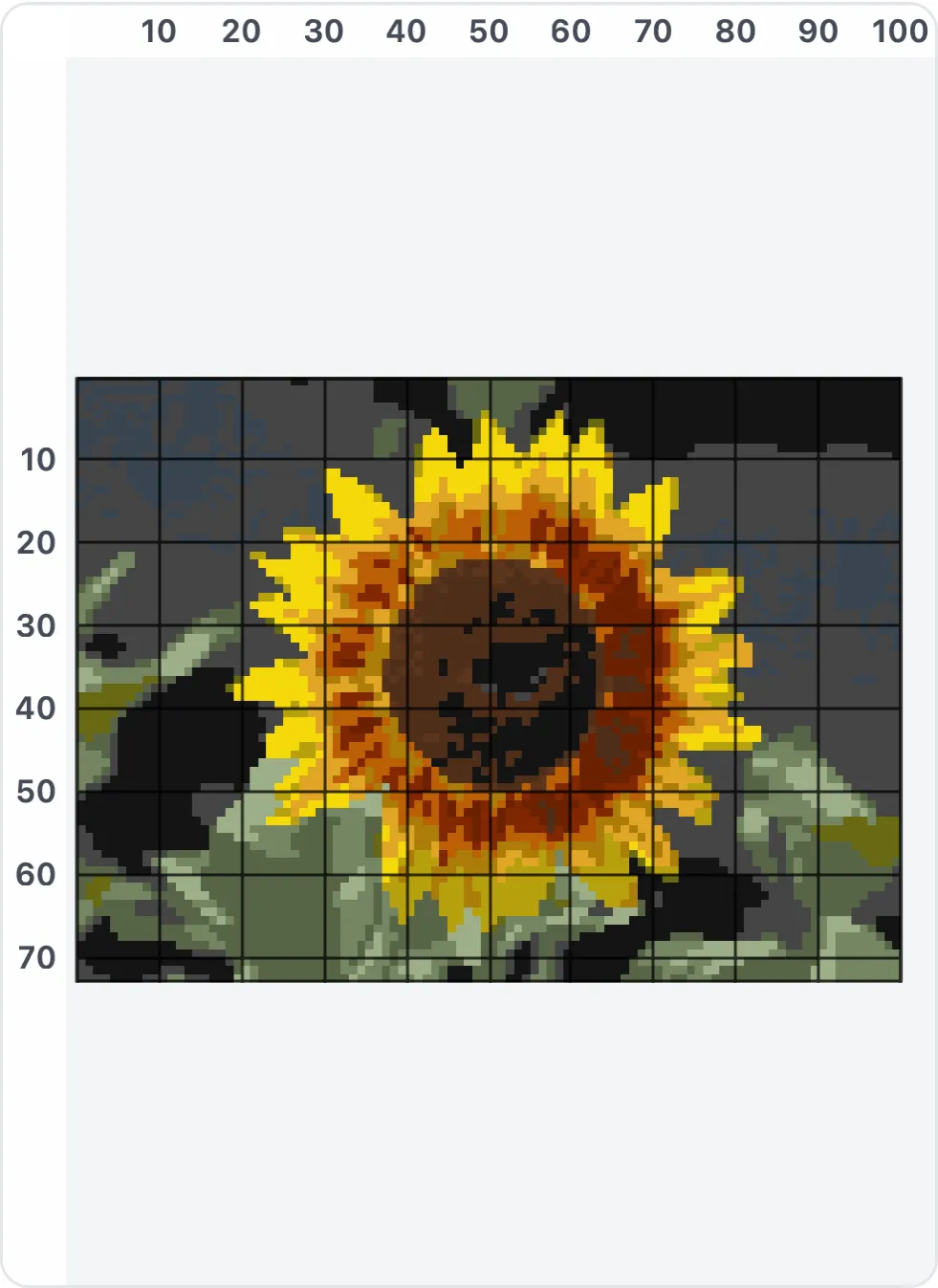
We charted a public-domain photo of a sunflower (1,280 × 928 pixels, by Wilfredo Rodriguez, CC0) at 100 stitches wide with up to 16 colors on 13-mesh canvas:
- Chart: 100 × 73 stitches, 7,300 tent stitches, 16 colors. The dark background takes the most stitches: 1,815 in the darkest gray and 1,221 in black.
- Size: 7.7 × 5.6 inches (19.5 × 14.3 cm). Canvas to cut: 11.7 × 9.6 inches, with 2 inches on every side.
- Wool: about 73 yards with the 15% margin, about 1.7 yards per square inch.
- Speed: 34 to 54 milliseconds for the chart and 0.15 to 0.27 seconds for the 6-page PDF over three runs, in Safari’s engine (Playwright WebKit 27.2) at an iPhone 15 screen size on an Apple M4 Mac.
How much wool will each color take?
We found no wool maker that publishes yarn per tent stitch, so Moonleaf works it out from the stitch itself. On the front, a tent stitch is one diagonal over a canvas intersection (√2 mesh). In basketweave the yarn travels about 2 mesh on the back to the next stitch. That makes about 3.4 mesh-widths of wool a stitch. Add 20% for working in 18-inch lengths that lose about 3 inches each to the needle and tails, and on 13 mesh that’s 0.32 inches a stitch, or about 1.5 yards per square inch before the safety margin.
Stitch choice changes it. Herrschners says basketweave uses about 30% more yarn than half cross, and continental about the same as basketweave. Half cross saves wool but leaves a thin back. Moonleaf’s figure is for basketweave, so it covers continental too.
Skein sizes vary by brand. Appleton’s FAQ gives about 10 m for a tapestry wool skein and about 55 m for a 25 g hank, so the tool starts at 10 m (10.9 yards). Type your own under Yards per ball or skein. Each color is rounded up to whole skeins, which is why a 16-color design needs more skeins than its yardage alone suggests: the sunflower’s 73 yards became 18 skeins.
How much canvas should I leave around the design?
Moonleaf adds 2 inches of bare canvas on every side by default; change it under More options. The margin is there for blocking (pinning the finished piece square while it dries) and for making it up into a pillow or a frame. DMC’s blocking guide adds one firm rule: “Never cut the canvas before blocking.”
Which wool and colors?
Moonleaf names each color from its 209 floss shades, with a swatch, so you can match them at the shop. For a sense of range, DMC’s tapestry wool comes “in 390 colors” (DMC’s product page), so most shades have a close wool match. If you already own a set of wools, switch Colors from to “My thread list” and paste their numbers, names and hex colors. The chart will use only those. DMC is a trademark of DMC; Moonleaf is not affiliated with DMC.
Cross stitchers can use the same method on Aida with the cross stitch pattern maker, and the Aida fabric size calculator works out fabric for any count. For colorwork with yarn rather than a needle, the tapestry crochet chart maker makes similar charts for single crochet.
Questions people ask
How do I turn a picture into a needlepoint pattern?
Choose the picture in the tool on this page, set the canvas mesh (holes per inch) and how many stitches wide the design should be. Moonleaf averages the picture into one color per stitch, keeps up to the number of colors you choose, and gives you a counted chart, a color key and wool amounts. It runs in your browser.
What mesh canvas should I use for a picture?
The higher the mesh, the more stitches per inch and the finer the detail. Common sizes are 10, 12, 13, 14 and 18. The same 100-stitch-wide pet portrait is 7.7 inches across on 13 mesh and 5.6 inches on 18 mesh, so choose the mesh for the finished size you want.
How much yarn do I need for needlepoint?
Moonleaf estimates about 0.32 inches of wool per basketweave stitch on 13-mesh canvas, which comes to about 1.5 yards per square inch, plus a 15% margin. Our 100 × 73-stitch sunflower came to about 73 yards. Basketweave and continental use more wool than half cross stitch.
What's the difference between basketweave and continental stitch?
Both make the same tent stitch on the front. Basketweave is worked in diagonal rows and makes a woven-looking back that holds the canvas square. Continental is worked in straight rows and tends to pull the canvas out of shape. Half cross uses the least wool but covers the back the least.
Do I need interlock or mono canvas?
DMC describes interlock canvas as two vertical threads trapping each horizontal one, which makes it stable and common in kits. Mono canvas has single woven threads. Either works for a tent stitch chart. Interlock is easier for beginners and for half cross stitch.
Related
- Cross stitch from a photoTurn any photo into a cross stitch pattern with symbols, a color key, skein counts and a printable PDF. Runs in your browser; nothing is uploaded.
- Aida fabric calculatorWork out how big your cross stitch will be and how much Aida, evenweave or linen to cut, for any stitch count, fabric count and framing margin.
- Tapestry crochet chartsTurn a picture into a tapestry crochet chart for rounds or rows, with color counts in working order and yarn amounts that include the carried strands.
- All Moonleaf toolsTurn a photo into a cross stitch, crochet or knitting chart