Tapestry crochet chart maker
Choose a picture below, pick 2 to 4 colors and the width in stitches, and Moonleaf makes a tapestry crochet chart (one square per single crochet) with every round or row written out in working order. Worked in the round, every round is read right to left; worked flat, the rows alternate. Because each unused color is carried inside every stitch, the yarn estimate counts the carried strands too. In our 3-color example they added about 40%.
Make a tapestry crochet chart from a photo
Runs in your browser. Nothing is uploaded. No sign-up.
No photo handy?
60 stitches wide · choose a photo to see the height
More options
Pinch or scroll to zoom, drag to move. Tap a color in the key to highlight it.
Moonleaf Pro is coming soon · $4.99 per chart or $14.99 lifetime
- The printable PDF: cover, color key with amounts, chart pages with a page map
- Written row-by-row instructions for C2C and row crafts
- Charts up to 400 stitches wide and 70 colors
Everything above is free while we launch. Leave your email and we'll write once, when Pro is ready.
How does tapestry crochet work?
Tapestry crochet is single crochet colorwork where the colors you aren’t using travel inside the stitches. Carol Ventura, whose books made the technique popular, puts it this way: “One or more yarns are carried while a yarn is being crocheted.” The carried yarn shouldn’t show on either side, and, in her words, “each yarn carried will slightly increase the height of the single crochet stitch”. The result is a stiff, dense fabric, good for bags, baskets, hats and wall hangings.
A tapestry crochet chart is a grid with one square per single crochet. You read it round by round (or row by row), switching to the color each square shows and carrying the rest.
How do I read the chart?
- In the round (most bags, baskets and hats): start at the bottom and read every round right to left. Carol Ventura offers separate graph paper for right-handed and left-handed rounds, because left-handers work the other way round. Sarah Maker’s guide gives the same rule.
- Flat: alternate, like a graphgan. Odd rows right to left, even rows left to right. Ventura notes that “flat tapestry crochet does not show the back of the stitches on every other row”, so flat pieces look slightly different on alternate rows.
Moonleaf starts in the round. Switch Worked under More options to “Flat, in rows” for flat pieces. Rows are numbered from the bottom and stitches from the right. The written list gives each round’s colors in working order, like “Rnd 2 ←: 12 B, 4 A, 1 B, 3 A…”.
A worked example: a 3-color lighthouse
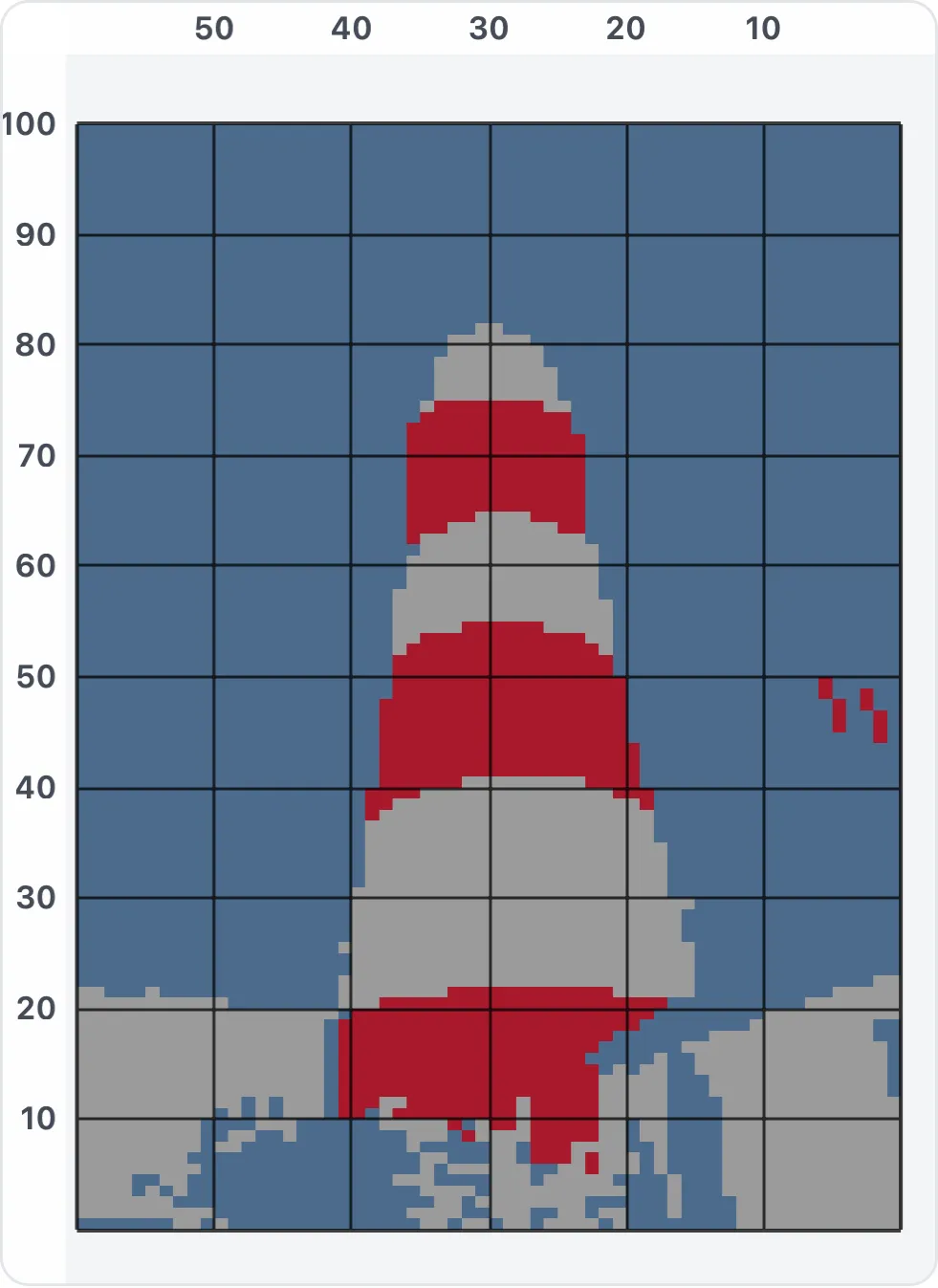
We charted a public-domain photo of Happisburgh Lighthouse (CC0) at 60 stitches around with 3 colors, at the single crochet gauge on Red Heart Super Saver’s label (12 stitches × 15 rows per 4 inches):
- Chart: 60 × 100 stitches, 6,000 single crochet, 3 colors: denim for the sky, gray, and cherry red for the stripes.
- Size: 20 inches around × 26.7 inches tall. A bag body is often shorter, so crop to the part of the picture you want.
- Yarn: about 486 yards with the margin. Of that, the stitches themselves use about 300 yards (at 0.05 yards a single crochet). Carrying the other two colors through every stitch adds about 122 yards, roughly 40% more, before the 15% margin.
- Speed: 15 to 25 milliseconds for the chart and 0.14 to 0.26 seconds for the 8-page PDF over three runs, in Safari’s engine (Playwright WebKit 27.2) at an iPhone 15 screen size on an Apple M4 Mac.
Why does my tapestry crochet lean, and does the chart account for it?
Single crochet worked in a spiral leans a little each round, so vertical lines drift sideways. Fixes from people who teach it:
- Yarn under instead of yarn over when you pull through. Ventura notes it slants less, though she suggests yarn over for zigzags and the bottoms of hearts.
- Back loop only, modified single crochet or waistcoat stitch (Sarah Maker’s list). These stand straighter but are taller, which stretches the design vertically.
The chart doesn’t skew the picture to fight the lean, because the lean depends on your hands, hook and stitch. If your stitches come out taller than the label gauge (carrying yarn makes them taller), measure a swatch and type your stitches and rows per 4 inches in the tool. The chart reshapes to match.
How is the yarn worked out?
Two parts per color:
- Worked stitches × 0.05 yards (about 1.8 inches of worsted per single crochet, Shiny Happy World’s estimate).
- Carried stitches: every stitch in another color carries this one through it, about one stitch-width of yarn (plus 10% slack). At 12 stitches per 4 inches that’s a third of an inch a stitch.
Then a 15% safety margin, and each color rounded up to whole skeins (364 yards, a Red Heart Super Saver solid, by default). That’s why a tapestry piece needs noticeably more of the background color than a graphgan of the same size.
Which pictures work best?
Strong shapes in 2 to 4 colors: a silhouette, a logo, a simple flower, a geometric border. Every color is carried everywhere, so a fifth color makes the fabric thicker and stiffer. Keep Remove confetti on. Single stitches of a color are fiddly when three strands are traveling with you. Use Background: one plain color to merge a busy background into one shade.
For a softer blanket where colors don’t travel through every stitch, try the graphgan pattern maker, or the C2C pattern maker for quick, chunky picture blankets (the C2C graph size calculator sizes those in tiles). The alpha bracelet pattern maker does the same kind of small, bold chart for knotted friendship bracelets.
Questions people ask
What is tapestry crochet?
Colorwork in single crochet where the colors you aren't using are carried inside the stitches, hidden front and back. Carol Ventura, who wrote the books on it, describes it as "one or more yarns are carried while a yarn is being crocheted". It makes a dense fabric used for bags, baskets, hats and wall hangings.
How do you read a tapestry crochet chart?
Worked in the round, read every round right to left, starting at the bottom. Worked flat, alternate, the way you'd read a graphgan. Left-handed crocheters reverse both directions (Sarah Maker). Moonleaf writes each round or row in working order.
Why does my tapestry crochet lean?
Single crochet worked in the round slants a little each round. Carol Ventura notes that working yarn-under slants less. Sarah Maker lists other fixes, such as single crochet in the back loop only or waistcoat stitch, but taller stitches stretch the design vertically, so swatch first.
How many colors can I use in tapestry crochet?
Two to four is typical, because every color is carried through every stitch, and each carried strand makes the stitch a little taller and the fabric thicker. Moonleaf allows up to 6. Our example uses 3.
What's the difference between tapestry crochet and mosaic crochet?
Tapestry crochet changes color within a row and carries the other colors inside the stitches. Mosaic crochet works one color per row and makes the pattern by dropping stitches down into earlier rows, so nothing is carried.
Related
- Graphgan pattern makerTurn a picture into a single crochet graphgan chart with row-by-row color counts, true stitch proportions, yarn yardage and a printable PDF.
- C2C crochet from a pictureTurn a picture into a corner-to-corner crochet graph with written row-by-row color counts, tile totals, yarn yardage and a printable PDF. Free.
- Alpha bracelet patternsTurn a picture into an alpha friendship bracelet pattern with one square per knot, rows written out with knot direction, and the base strings to cut.
- All Moonleaf toolsTurn a photo into a cross stitch, crochet or knitting chart