How to read a cross stitch chart
Each square on a cross stitch chart is one full cross stitch on the fabric, in the color its symbol stands for in the key. Bold lines mark every 10 squares so you can count, and the arrows on the edges point to the middle row and column. Find the center of your fabric, start there, and stitch one color at a time, counting squares from the bold lines.
What does each square mean?
A cross stitch chart is a map of your fabric. DMC’s guide to reading a chart says the squares on the chart correspond to the squares of the fabric. So each square is one full cross stitch: on Aida, one cross over one square; on evenweave or linen worked “over two”, one cross over two threads each way.
Inside each square is a symbol, a color, or both. The key (or legend) lists every symbol with its thread: number, name and how many skeins. Moonleaf’s key, for example, shows the symbol drawn on the floss color, the color’s code and name, the number of stitches and the skeins to buy:
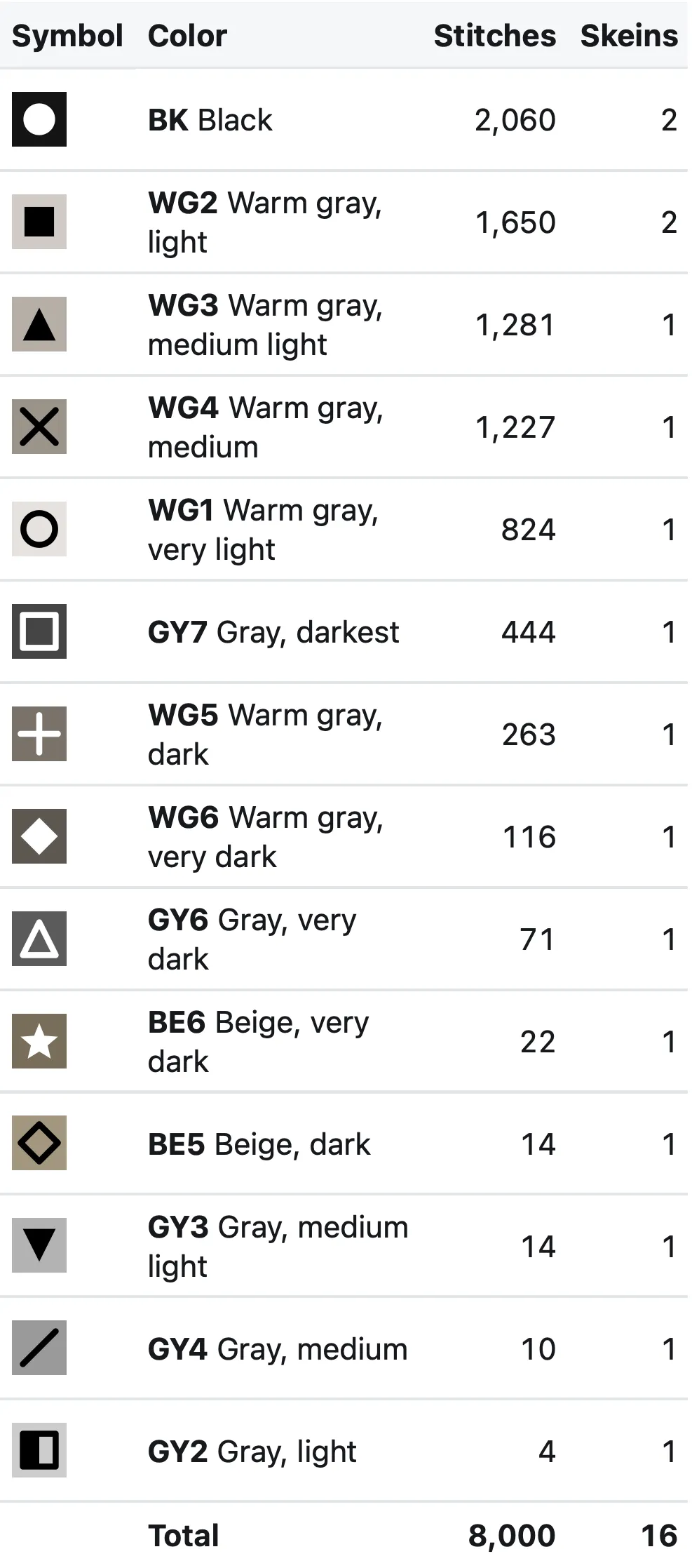
Empty squares are left unstitched: the fabric shows through. Charts made from photos often fill every square; samplers and motifs leave a lot empty.
What do the lines, numbers and arrows mean?
- Thin lines separate the squares.
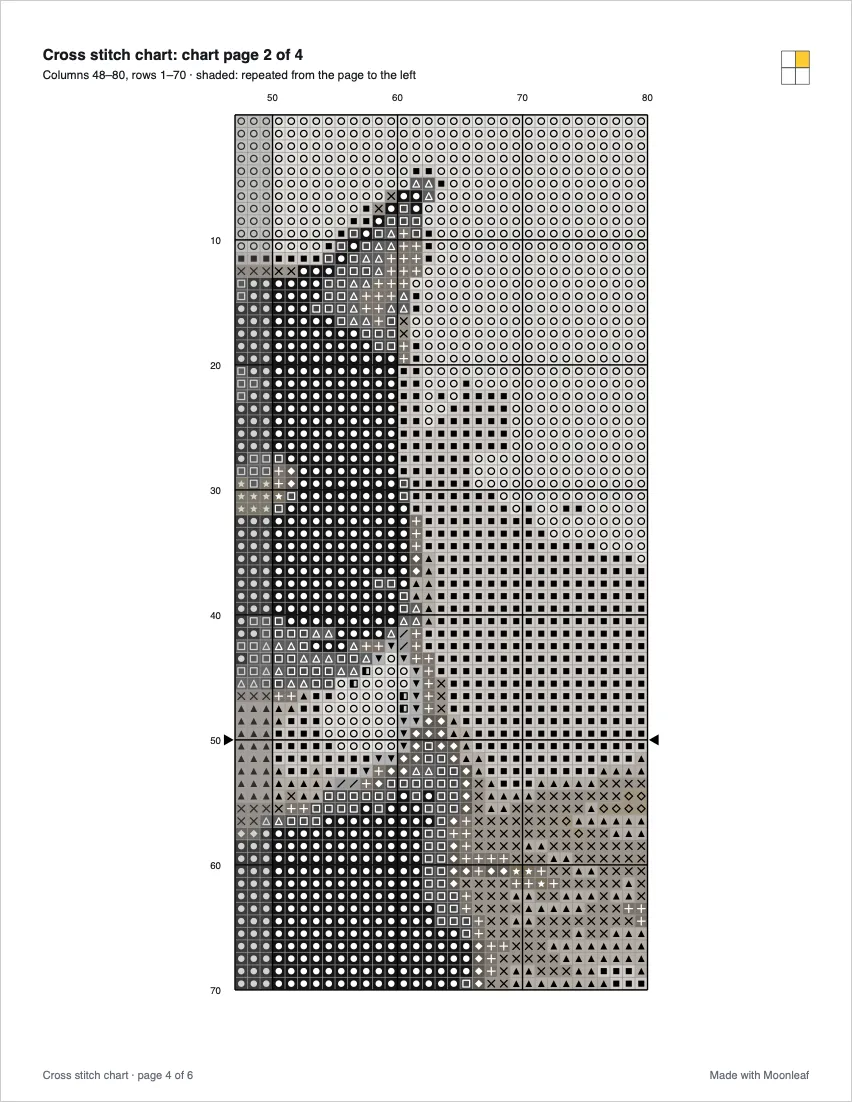
- Bold lines every 10 squares. LoveCrafts’ guide to reading a pattern calls them darker lines marking out 10 × 10 sections. Count from the nearest bold line, never from the edge of the chart.
- Numbers along the edges count the columns and rows in tens, so you can say “row 40, column 23” and find it again.
- Arrows on the four edges point to the middle column and the middle row. DMC says to “follow the four arrows… where they all intersect” to find the center. Moonleaf draws them as small black triangles.
Here’s a chart page from a Moonleaf PDF. Bold lines every 10, numbers every 10, the center triangles on the edges, and on this page the first 3 columns shaded because they repeat the page to the left:
Where do I start stitching?
In the center, for most charts:
- Find the center of the chart where the arrows meet.
- Find the center of the fabric: fold it in half one way and then the other; the center is where the folds cross. Mark it lightly or with a pin.
- Stitch outward from that point, so the design ends up centered with an even margin all round. That’s why the Aida fabric size calculator adds the same margin to every side.
A worked example: our cat chart is 80 × 100 stitches, so its center is between columns 40 and 41 and rows 50 and 51. On 14-count Aida with 3-inch margins, the fabric is 11.7 × 13.1 inches, and the center of the fabric is the center of the design.
How do I follow the colors without getting lost?
Most stitchers work one color at a time in a small area, often one 10 × 10 block:
- Pick a block near the center.
- Choose one symbol from the key, thread that color, and stitch every square with that symbol in the block.
- Cross off or highlight each stitch on the chart as you go.
- Move to the next color, then the next block.
On a printed chart, people cross stitches off with a pencil or highlighter. On a phone or tablet, a pattern keeper does it: tap a color to highlight just its squares, then tap or swipe to mark them done. Moonleaf’s keeper is free in Safari for charts made here. The Pattern Keeper alternatives guide compares the apps that also open designers’ PDFs.
What about backstitch, French knots and fractional stitches?
Charts from designers often add details on top of the full stitches:
- Backstitch: DMC describes it as “a straight line or dotted line that joins two corners” of the squares, worked after the crosses, usually for outlines and lettering.
- French knots: LoveCrafts notes a French knot is drawn as a round dot.
- Fractional stitches (half, quarter and three-quarter stitches): DMC names them, but how they’re drawn varies between designers, so check the pattern’s own key.
Charts made with Moonleaf from photos use full stitches only, which is simpler to stitch and to track.
How do I read a chart that’s split over pages?
Large charts don’t fit on one page, so they’re split into sections:
- The page map shows which page covers which part of the design. In Moonleaf’s PDF it’s on the cover, and each chart page has a small one in its corner.
- The column and row numbers carry on across pages, so row 71 on one page follows row 70 on the page above.
- Overlap: Moonleaf repeats the last 3 rows and columns of the page before, shaded. Don’t stitch the shaded squares twice; use them to line up.
Before you buy floss, check the key’s skein column, or work it out from the stitch counts with how many skeins of floss do I need.
Try it on a chart of your own
The tool below turns any photo into a chart with everything described above: symbols, a key, bold lines every 10, row and column numbers, center arrows and a page map in the PDF.
Make a cross stitch chart from a photo
Runs in your browser. Nothing is uploaded. No sign-up.
No photo handy?
80 stitches wide · choose a photo to see the height
More options
Pinch or scroll to zoom, drag to move. Tap a color in the key to highlight it.
Moonleaf Pro is coming soon · $4.99 per chart or $14.99 lifetime
- The printable PDF: cover, color key with amounts, chart pages with a page map
- Written row-by-row instructions for C2C and row crafts
- Charts up to 400 stitches wide and 70 colors
Everything above is free while we launch. Leave your email and we'll write once, when Pro is ready.
Questions people ask
What does each square on a cross stitch chart mean?
One full cross stitch, worked over one square of Aida (or two threads each way on evenweave). The symbol or color in the square says which thread to use, and the key lists every symbol with its thread.
Where do I start on a cross stitch chart?
Usually in the middle. DMC's guide says to follow the four arrows on the chart's edges to where they meet. Fold your fabric in half both ways to find its center, and stitch outward from there so the design ends up centered.
What do the bold lines on a cross stitch chart mean?
They mark every 10 squares, which makes counting much easier. LoveCrafts puts it as darker lines marking out 10 × 10 sections. Count from the nearest bold line rather than from the edge.
How are backstitch and French knots shown?
DMC describes backstitch as a straight or dotted line joining two corners of the squares, and LoveCrafts shows a French knot as a round dot. The key says which thread each line or dot uses. Moonleaf's charts are full stitches only.
How do I follow a chart that's split over several pages?
Use the page map to see how the pages fit together, and the row and column numbers to line them up. Moonleaf's PDFs repeat the last 3 rows and columns of the page before, shaded, so you can find your place at a page edge.
Should I stitch one color at a time?
Most stitchers do. Work one color across a 10 × 10 block or a small area, then the next color, crossing off each stitch as you go. A pattern keeper on a phone or tablet does the crossing off for you.
Related
- Cross stitch from a photoTurn any photo into a cross stitch pattern with symbols, a color key, skein counts and a printable PDF. Runs in your browser; nothing is uploaded.
- Aida fabric calculatorWork out how big your cross stitch will be and how much Aida, evenweave or linen to cut, for any stitch count, fabric count and framing margin.
- How many skeins of flossOne 8 m skein covers about 1,785 cross stitches on 14-count with 2 strands. Work out skeins per color for any count and strands, with a margin.
- Pattern keeper for iPhone and iPadPattern Keeper is Android-only. The iPhone and iPad apps that open cross stitch PDFs, compared, plus Moonleaf's free in-browser pattern keeper.
- All guidesEvery Moonleaf guide, by task.